The Asset Management industry is on a hunt to identify how to operate more efficiently and effectively. Almost all firms are looking to deliver automation, more intelligent decision making and to make better use of their salespeople.
Within the client groups of Asset Managers, especially across Sales and Marketing, “Content and Sales Enablement” has been billed as a way of ticking all of these boxes.
What We Mean by Content and Sales Enablement:
As a broad term “Content and Sales Enablement” often means different things to different people. For the purposes of this article, Content and Sales Enablement means tools which:
- Enable sales teams to access the content they need and distribute it to clients
- Automates content updates and provides a capability for tailoring
- Delivery of data driven content and client insights, understanding client engagement and content performance
The Rise of Sales Enablement for Asset Management
Over the past 15 years, Content and Sales Enablement as a capability has risen in prominence to the point where 23 of 25 of the top global asset managers by AUM have adopted Content and Sales Enablement platforms (Source: Seismic). We have seen several platforms (e.g. Seismic, Assette and others) deliver a combination of these capabilities to asset managers.
Ultimately, the outcomes asset managers are looking to achieve from these platforms are to deliver central hubs for compliant, high-quality content, data automation and client insights—designed to better equip sales teams, enhance client engagement, and deliver better client outcomes.
This can result in tangible enhancements to the capability of sales teams. We see this in our research: firms with more advanced technology stacks (including Sales Enablement) are generating 66% more flows (Source: Alpha’s 2025 Digital & Marketing Survey) than those in less mature firms.
So, What is the Problem? Reliably Getting Value Out of These Tools…
Despite the hype, a common story emerges: firms invest heavily but often struggle to see meaningful returns.
Why? Because success isn’t about the tool alone. There are three key pitfalls we see when firms fail to see success from their enablement programmes:
- Not appreciating that Content and Sales Enablement is a part of a broader cultural change and not just a technology implementation
Deployment of a Content and Sales Enablement platform represents a fundamental change to how client groups need to think about content and the role of sales teams. It requires a clear and ambitious vision of how sales and marketing teams operate together and how their technologies and processes align
- Not treating content and data as enterprise assets
To deliver deep automation at scale, content and data need to be in a position where automation becomes possible. This means delivering a suite of common content components and associated data sets which can be used flexibly to build the content required by the business
- Not putting people around Content and Sales Enablement as a core capability
To maintain a successful sales enablement capability there needs to be ownership of the platform across the production and management of the content it holds, the development of the platform, the delivery of client insights as the content and client landscape evolves
Has anyone really managed to unlock the full value?
Yes.
While challenging, it’s not only possible but increasingly common. Leading firms have harnessed these platforms effectively by investing in foundational elements and embedding content and sales enablement into their operating model. The result? Better client engagement, more productive sales conversations, and demonstrable ROI.
Examples of the benefits we have seen:
- $1.5M/year saving through optimised content production
- Halved content time to market
- 23,000 hours of sales team time saved
How to Deliver these benefits reliably?
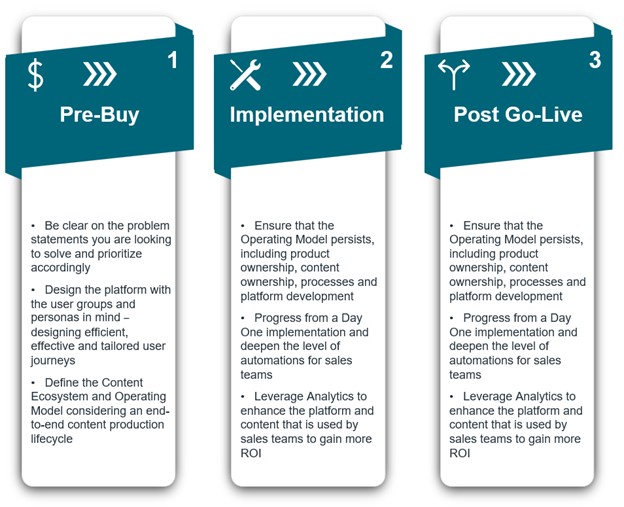
Wherever firms are on the journey, there are ways to extract optimal value out of their Content and Sales Enablement platform.