
Today’s Clients Expect More Than “Off-the-Rack” Content
Just like tailoring a suit to your perfect fit, content in asset management should feel customized – reflecting each client’s unique needs, style, and size. Clients increasingly expect this level of personalization in both the products asset and wealth managers are offering, as well as the communications that support them. However, as with over-tailoring a suit, excessive customization can undermine structure – introducing operational inefficiencies, compliance risks, and brand inconsistency. The goal isn’t to craft a bespoke piece for every individual, but to build a scalable system that feels tailored without sacrificing efficiencies. With smart segmentation, componentized content, and strong governance, firms can deliver content that is compelling and effective for investors needs and interests – like a fitted suit designed to last.
What level of personalization creates value and where does it just create drag?
When Personalization Becomes a Problem
While personalization can be a strategic differentiator and necessary to both attract and retain investors, excessive customization introduces real risks. A lack of standardized messaging may cause compliance and disclosure complexity and errors, while operational processes – such as content production, review, and distribution can become inefficient and difficult to scale. For example, when creating multiple variations of product commentary to meet customization requests, you run the risk of losing a consistent brand identify and increasing operational overhead for content production. These issues carry serious consequences, from regulatory fines to lost productivity and reputational damage.
So how do firms deliver content that feels personalized without creating chaos behind the scenes?
How to Effectively Manage Personalization
To manage personalization effectively, firms must define clear boundaries between what should be customized and what must remain standardized. A tiered framework that strikes the right balance can help to support this:
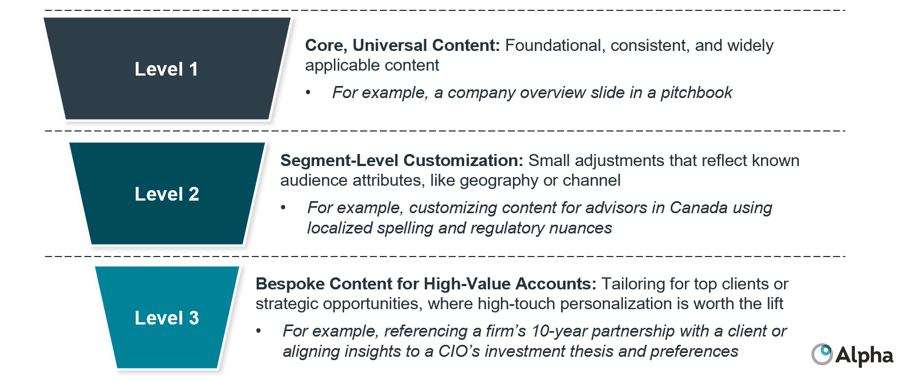
Recognizing warning signs of over personalization, such as an increasing volume of ad hoc requests and manual workarounds to produce content, can help teams course correct before efforts become unsustainable. Alignment among all involved teams on the appropriate level of customization is essential – just as crucial is empowering content creators to confidently say ‘no,’ when the benefit does not outweigh the cost.
How can firms develop a scalable model to operationalize personalization?
How to Operationalize Personalization
To avoid spiraling into content chaos, firms need infrastructure that supports personalization with control. Four key enablers make this possible:
- Smart Segmentation
- Build personas based on meaningful traits – advisor type, AUM tier, buying stage – not just region or channel. The sharper the segmentation, the more scalable the tailoring
- Modular, Metadata-Rich Content
- Break down core materials into building blocks – firm story, fund data, market views – each tagged with a focus on the metadata that matters. This lets teams assemble custom-looking decks with minimal manual work
- Governed Flexibility
- Empower distribution and regional marketers with personalization “guardrails.” Central teams can set brand, risk, and compliance parameters while enabling local teams to adapt content responsibly
- Automation and AI
- Tools like Seismic and Workfront, paired with AI, can dynamically adapt content by language, segment, or relationship – reducing manual lift and increasing consistency
Personalization That Scales, Not Breaks
Personalization in asset management must be intentional, not improvised. The goal is to create a content wardrobe that feels tailored but is built to scale. By doing so, teams can deliver tailored content that resonates – without creating chaos behind the scenes.
About the Authors

Rebecca Dunkelman
Manager
Rebecca is a Manager within Alpha's North American team and a member of the Client & Digital practice. She has an extensive track record supporting a range of asset management clients through various strategic and operational change projects, with particular background in content and distribution work.

Jacky Fu
Partner, Head of Reporting & BI Solutions
Jacky is a Partner within Alpha's North American team and leads the Reporting & BI Solutions proposition within the region. He is a trusted advisor to senior leadership across a range of asset management clients, and has successfully delivered strategic client outcomes for the Client & Digital practice, with specific focus on reporting design and delivery.

Steve Garrison
Senior Manager
Steve is a Senior Manager within Alpha's North American team and a member of the Client & Digital practice. He has a strong background leading a variety of transformation projects across our asset and wealth management client base, having driven successful target operating model designs, technology implementations, and various other strategic initiatives for complex clients.